

Business owner CPP timing is one of the most overlooked retirement income decisions in Canada, and Q3 is the perfect time to fix that. It’s July. The halfway point of the year. Most business owners are reviewing revenue, adjusting projections, and planning the back half of the year.
But there’s one question that almost never makes the list: when should I actually start drawing CPP, and is the answer different because I own a corporation?
The short answer is yes, the answer is different. Especially if you’ve been paying yourself in dividends.
And the longer you leave this unexamined, the more likely you are to end up with a default outcome rather than a deliberate one.
The Three Options Nobody Fully Explains
You can start drawing CPP as early as age 60 or as late as age 70. The difference between those two endpoints is significant, and the math doesn’t work the same way for everyone.
Here’s how it breaks down:
Start at 60: your benefit is reduced by 0.6% for every month before age 65, which means a 36% reduction off your age-65 amount. You get less per month, but you get it for longer.
Start at 65: the baseline. No reduction, no increase. This is what most people think of as the default.
Start at 70: your benefit increases by 0.7% for every month after age 65, which means a 42% increase over your age-65 amount. You get significantly more per month, but you wait five years to start.
The question of which option is best depends entirely on your health, your other income sources, your tax situation, and how long you expect to live. There is no universal right answer, but there is a right answer for your situation.
CPP timing isn’t a government form you fill out. It’s a retirement income decision that compounds for the rest of your life.
The Breakeven Math
The most common framework for thinking about CPP timing is the breakeven age: the point at which a later start date overtakes an earlier one in total lifetime payments.
If you start at 65 instead of 60, you give up five years of payments but receive more per month. The crossover point, where 65 beats 60 in cumulative payout, lands around age 74. If you start at 70 instead of 65, the crossover against 65 lands around age 83.
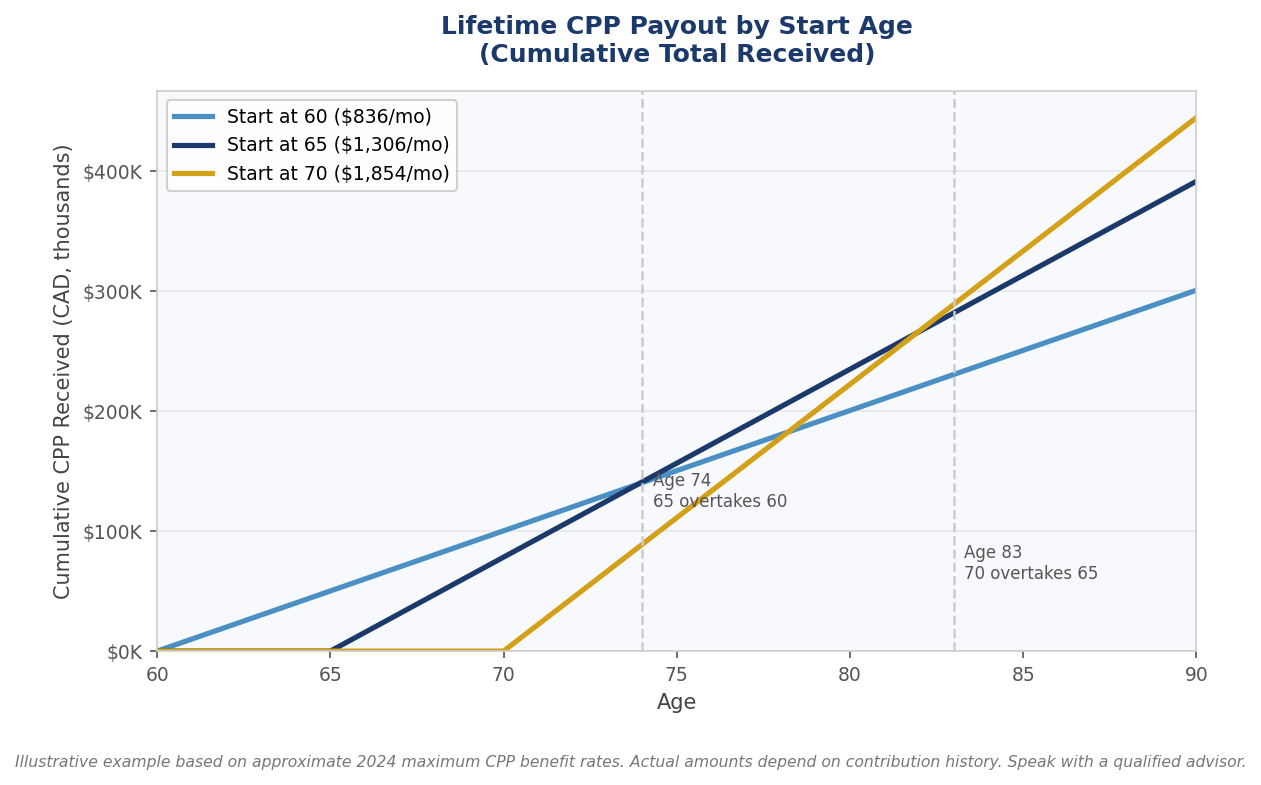
What the chart makes clear is that longevity is the single biggest variable. If your family history and current health suggest you’re likely to live into your mid-80s or beyond, waiting pays off significantly. If you have health concerns or a shorter family history, taking it earlier makes more sense.
For business owners specifically, there’s another layer: tax. If you’re still drawing income from your corporation in your early 60s, adding CPP on top of that income may push you into a higher bracket. Deferring CPP to a lower-income period can reduce the net tax hit on those payments.
The Part Most Business Owners Don’t Know
Here’s where it gets specific to incorporated owners: your CPP entitlement is directly tied to how much you’ve paid into it over your working life. And how much you’ve paid into it depends entirely on how you’ve been paying yourself.
CPP contributions are only triggered on salary, not on dividends. If you’ve been paying yourself primarily or entirely in dividends, which many incorporated owners do for tax efficiency reasons, your CPP entitlement at 65 may be significantly lower than you expect. In some cases, it’s close to zero.
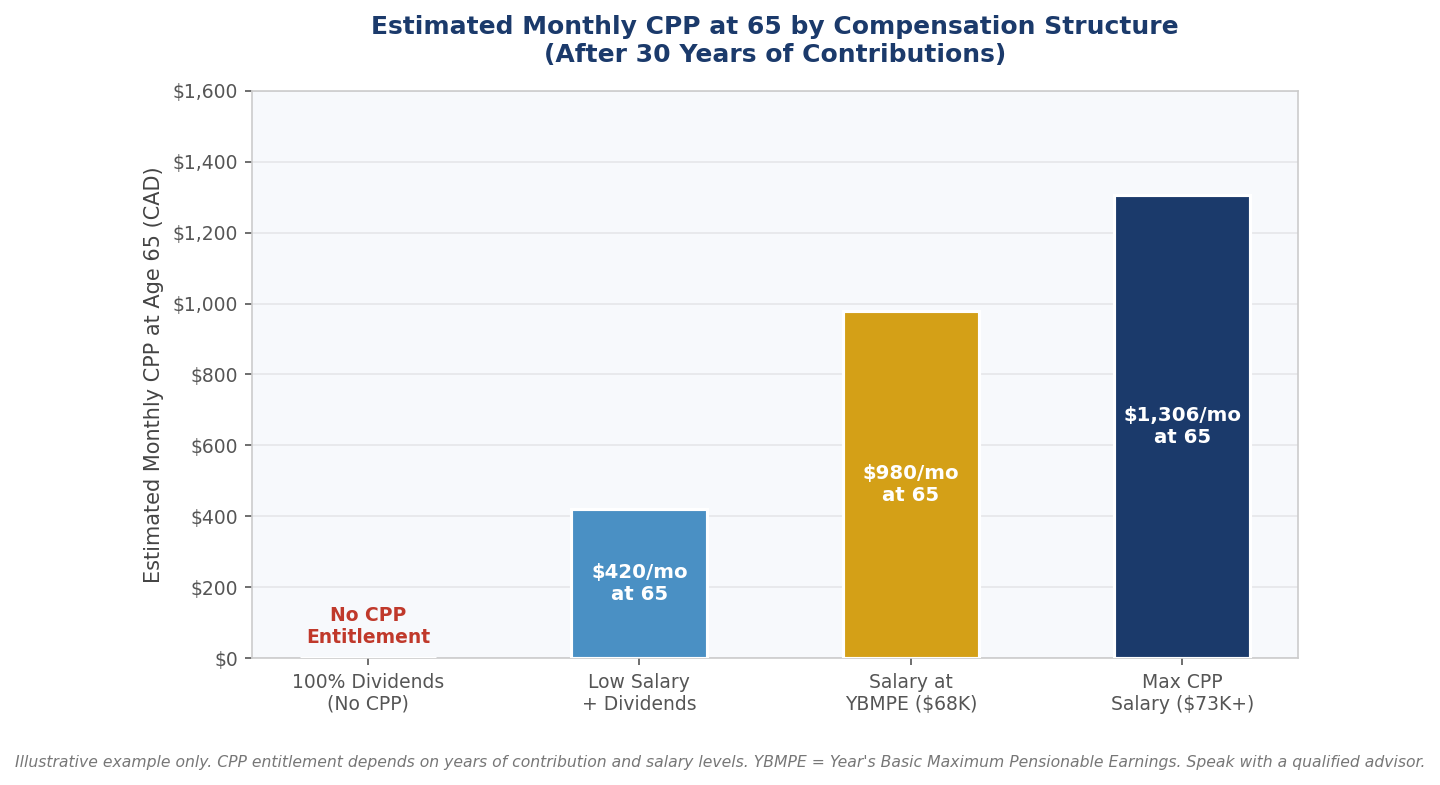
This is one of the most common surprises I see when business owners start thinking seriously about retirement. They’ve been incorporated for 20 or 25 years, they know CPP exists, and they assume they’ll receive a meaningful benefit. Then they check their My Service Canada account and realize years of dividend income left almost nothing on the table.
This doesn’t mean dividends were the wrong choice. The tax savings over those years may well outweigh the CPP shortfall. But it does mean CPP can’t be counted on as a retirement income pillar the way it might be for an employee, and your retirement income plan needs to account for that gap.
If you’ve been paying yourself in dividends, your CPP might be smaller than you think. Your retirement plan needs to know that now.
What to Do With This in Q3
The mid-year mark is a natural time to revisit this. Not because CPP timing needs to be decided today, but because the decisions you’re making right now about compensation structure are quietly shaping your CPP entitlement for years to come.
A few things worth reviewing before the end of summer:
Check your CPP Statement of Contributions through My Service Canada. It shows exactly what you’ve paid in and what your projected benefit looks like at 60, 65, and 70.
If your projected CPP benefit is low because of years of dividend income, factor that gap into your retirement income projections and make sure other sources, RRSP, IPP, corporate investments, are sized to compensate.
If you’re still a decade or more from retirement and your salary is currently below the Year’s Maximum Pensionable Earnings, consider whether adjusting your salary vs. dividend mix could meaningfully improve your CPP entitlement before it’s too late.
If you’re approaching 60, talk through the timing decision now rather than defaulting to 65. The right answer depends on your health, your other income, and your tax picture in retirement.
None of this is complicated once you have the right information in front of you. The issue is that most business owners never pull that information together until they’re already close to making the call.
If you want to review your CPP picture alongside your broader retirement and compensation strategy, I’m always happy to start that conversation. Book an online consultation or reach out to our team.