

Succession ran for four seasons because Logan Roy built something extraordinary and never sorted out what happened to it. The Roys had lawyers, advisors, and boardrooms full of people. What they didn’t have was a plan. Most business owners are closer to that situation than they’d like to admit.

Most business owners spend years building toward an exit. The late nights, the reinvested revenue, the decisions made with one eye on the long game. When the time finally comes to sell, it feels like the hard part is done.
But here’s what I see time and again: the financial planning that happens in the 12 to 36 months before a sale often determines how much of that value you actually walk away with. Not the negotiation. Not the multiple. The structure.
Pre-liquidity event planning for business owners is one of the highest-value conversations I have. And it’s almost always the one that happens too late. Here are five things worth reviewing now, before the timeline gets urgent.
1. The Lifetime Capital Gains Exemption and Your Family Trust
The Lifetime Capital Gains Exemption (LCGE) is one of the most powerful tools available to Canadian business owners selling a Qualifying Small Business Corporation. In 2026, each eligible individual can shelter up to $1,275,000 of capital gains from tax on the sale of qualifying shares. With the capital gains inclusion rate remaining at 50% in 2026, that exemption can be worth roughly $330,000 in personal tax savings per individual at the top marginal rate in BC.
The key word is each. If a family trust holds shares in your company and your spouse and adult children are beneficiaries, each of them may be able to claim their own LCGE on gains allocated through the trust. On a $3 million sale, the difference between one exemption and three is significant.
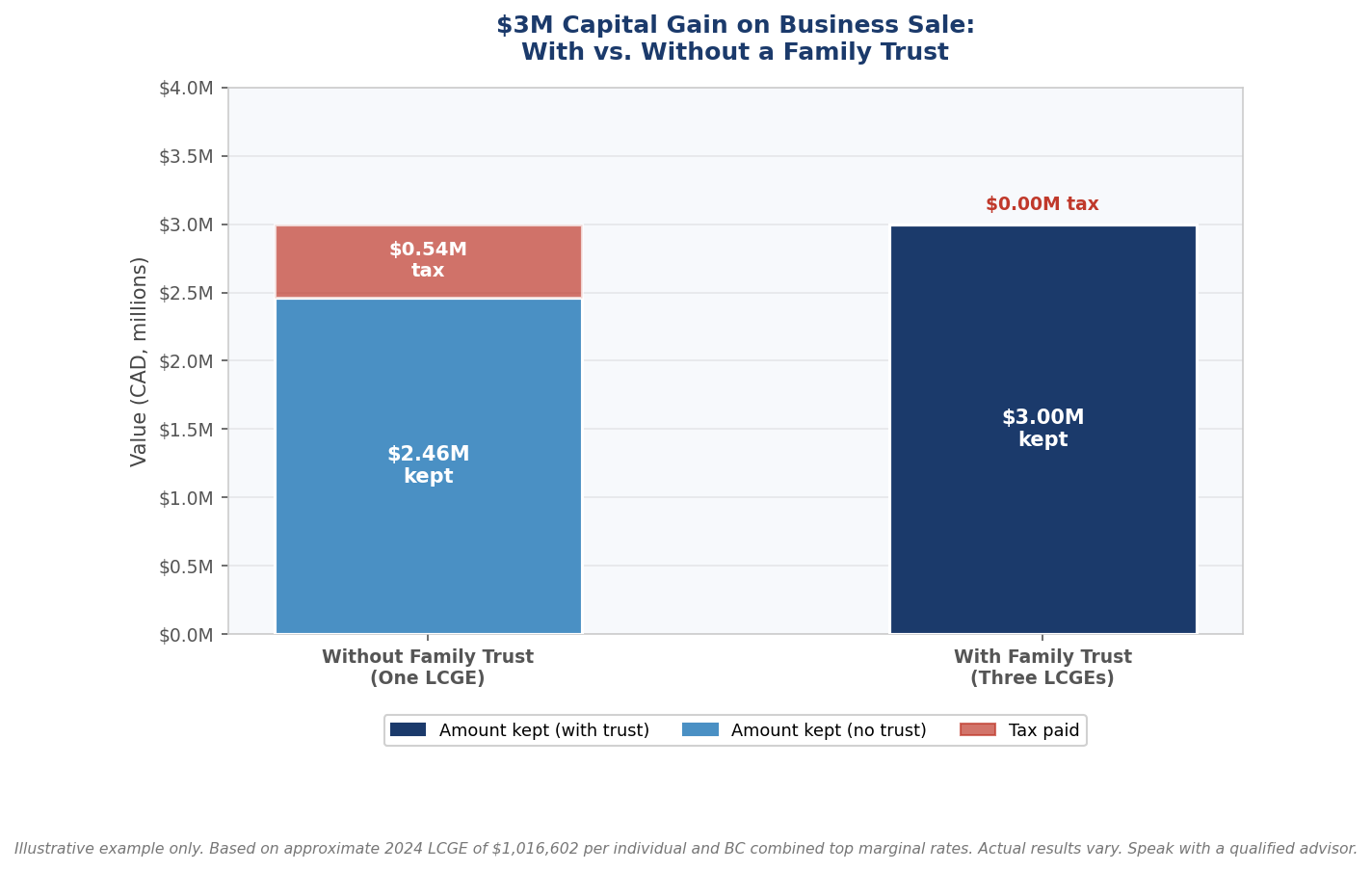
As the chart shows, a properly structured family trust can meaningfully reduce the tax burden on a sale by multiplying the number of exemptions available. The catch: this structure needs to be in place well before the sale. Setting up a trust immediately before a transaction raises attribution concerns and may not achieve the intended result.
If you don’t have a family trust and an exit is on the horizon, this is the first conversation worth having.
The LCGE is one of the most valuable tax shelters available to Canadian business owners. A family trust can multiply it. But timing is everything.
2. Purification: Does Your Company Actually Qualify?
To access the LCGE, your shares need to qualify as shares of a Qualifying Small Business Corporation (QSBC). One of the key requirements is that at least 90% of the fair market value of your company’s assets must be used in an active business at the time of the sale, and at least 50% must have been used that way throughout the preceding 24 months.
This is where a lot of business owners run into problems they didn’t know existed.
Excess cash sitting in the operating company, passive investments, real estate held inside the corporation, or a foreign subsidiary that doesn’t meet the definition of an active Canadian business can all create what’s called a purification issue: your shares may not qualify for the LCGE at all, or may only partially qualify.
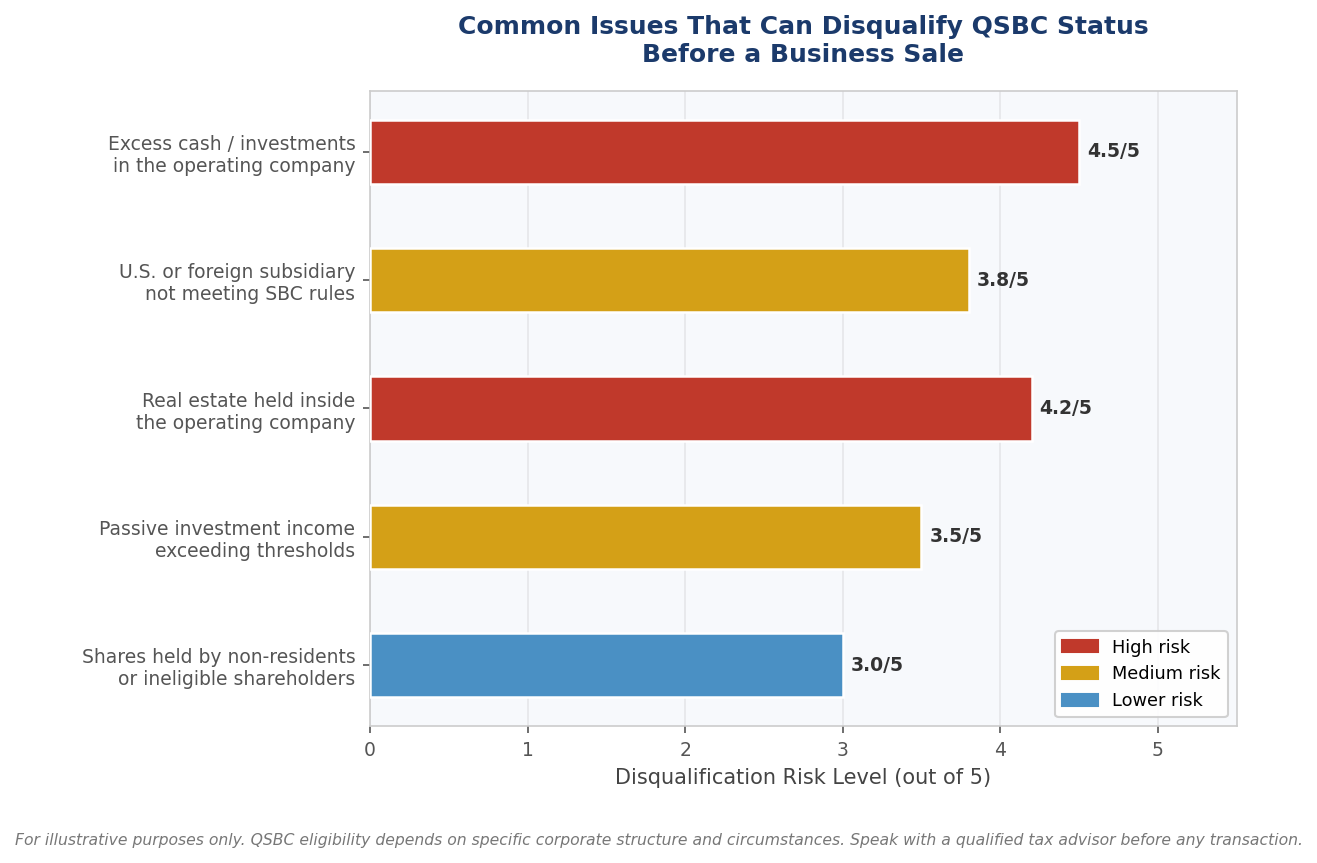
Purification strategies exist, but they take time. Moving excess cash out of the operating company, reorganizing assets, or winding down a problematic subsidiary all need to happen well in advance of a sale. If you wait until there’s a deal on the table, your options narrow significantly.
This is also why coordinating with your accountant early matters. The structure of your corporation today determines what’s available to you at the closing table.
3. Your Shareholder Loan
If you have a shareholder loan balance, money you’ve lent to your corporation over the years, a liquidity event creates an important opportunity.
At the time of a sale, shareholder loans are typically repaid to you tax-free, since you’re simply recovering your own money that was previously lent to the company. Depending on the size of that loan, this can represent a meaningful amount of capital that comes back to you without triggering additional tax.
The question is what you do with it. A shareholder loan repayment at a liquidity event is an ideal time to maximize your TFSA, top up your RRSP if you have room, or seed a personal investment portfolio. These are decisions worth planning in advance rather than figuring out in the weeks after a sale closes.
If your shareholder loan has been sitting unchanged for years, it’s worth reviewing the balance and thinking through how it fits into your overall post-exit financial plan.
A shareholder loan repayment at a liquidity event is tax-free capital. The question is whether you have a plan for it before it arrives.
4. Converting Term Life Insurance Inside Your Holdco
Many business owners carry significant term life insurance, often held through their operating or holding company. Term insurance serves an important purpose, but it has a built-in problem: it expires. And when it does, you may need to qualify medically for new coverage at a time when that’s more difficult or more expensive.
Most term policies include a conversion privilege that allows you to convert some or all of your coverage to permanent insurance without new medical underwriting. This means your health at the time of conversion is irrelevant. You qualify based on the original policy.
For business owners holding significant term coverage inside a holding company, this conversion can be done in a way that builds cash value inside the holdco, creates a future Capital Dividend Account credit, and removes the expiry risk from your coverage, all without going through underwriting again.
The window to do this is limited. Conversion privileges typically expire at a set age or policy anniversary. Reviewing what’s available inside your existing policies before that window closes is worth doing regardless of where you are in your business lifecycle.
5. Individual Pension Plan Eligibility
If you haven’t evaluated your eligibility for an Individual Pension Plan, a sale or liquidity event is often the trigger that makes this especially worth doing.
An IPP is a defined benefit pension plan for incorporated business owners. Its contribution room grows with age and years of T4 salary history, and in some cases, past service can be funded retroactively using corporate assets. For an owner in their late 40s or 50s approaching an exit, this is actually one of the strongest arguments for setting up an IPP before the sale closes. Once the business is sold and the employer-employee relationship through the corporation ends, the ability to contribute is gone. The window to maximize that contribution room, including any past service funding, is while you still own it.
The planning around an IPP also connects directly to your salary vs. dividend strategy in the years before a sale. Maximizing your T4 salary in those years can significantly increase your IPP contribution room and the benefit available at retirement.
An exit isn’t just about what you get at the closing table. It’s about how much of it you keep, and what it does for you after.
The Conversation That Happens Too Late
Every one of these five items has a common thread: they all require lead time. A family trust needs to be set up years before a sale. Purification strategies need runway. Shareholder loan planning works better when it’s not rushed. Conversion privileges expire. IPP setup takes time to optimize.
The business owners who walk away from a sale with the most are almost always the ones who started these conversations early, not because they were certain a sale was coming, but because they understood that the structure you build in normal times is the structure you’re working with when it counts.
A few questions worth asking yourself now:
Do you have a family trust in place, and have you reviewed whether your family members could access their own LCGE ($1,275,000 per individual in 2026) on a future sale?
Has your accountant reviewed your corporate structure for potential purification issues?
Do you know your current shareholder loan balance and how it fits into your post-exit plan?
Have you reviewed the conversion privileges on any term insurance held inside your holdco?
Have you evaluated your IPP eligibility and how your current salary structure affects your contribution room?
If any of those feel uncertain, that’s exactly where the conversation should start.
If you want to talk through your pre-sale planning and what needs to be in place before a liquidity event, I’m always happy to start that conversation. It’s also worth looping in your accountant early, since the best outcomes almost always come from coordinated planning across your advisory team.
Book an online consultation or reach out to our team.